Saturday, 18 February 2017

Totoro

My daughters and I love the movie My Neighbor Totoro. If you haven't seen it, I recommend watching it and other movies by Studio Ghibli.
I decided that I needed a Totoro sculpture. At the time I started this project, my medium of choice was wool fiber. Since Totoro is gray and white, I could use naturally colored fibers to make it even easier.

This is the process of how I made my Totoro.

Undyed Targhee combed top
I start with loose wool fiber. The specific fiber that I'm using for this project is white Targhee (that's the breed of sheep) combed top. Targhee is pretty good for felting. Here it's shown in the washed, combed prep that is combed top.
The only tools I use to make these sculptures are a wicked looking needle and a block of foam to hopefully save my fingers from too much poking. Sometimes I'll use a bit of wire for armature, but Totoro won't need it. The needle is 3 inches long and has 9 little barbs on it that catch the fibers and push them into the sculpture, felting it.


A basic Totoro shape
 The first step was to rough out a shape. Since Totoro is kind of a big oval, that wasn't too difficult. I will worry about things like noses, ears, arms and legs later.

Making the gray parts gray
 Then I needed to start making the gray areas gray. On the right side, you can see where I added some fiber that I haven't stabbed into place yet and the needle that I'm using to do so.

Now with arms. One is ready to hold an umbrella
Arms! My plan is to make him holding an umbrella, so I put one arm up.

Legs to stand on
Legs! With each step, he's becoming more and more recognizable.

Ears
Ears! Are those his ears? I was never quite sure.

A tail helps him stand
Shortly after giving him legs, I also gave him a tail. I failed at getting pictures of his tail in progress, but here is his tail after I finished the rest of him.

The beginning of a mouth
He started looking a bit demonic at this point. I don't think that's totally inappropriate, but the mouth gave me trouble. It kept wanting to look crooked. I could have left him with a smirk, but was trying to make it look somewhat even. Looking carefully, you may be able to see a bump of a nose just above the center of the mouth. Totoro doesn't have much of a nose, but there is a definite bump seen in profile.


Tooth definition and eyes
I added some black for his nose and started adding the eyes and divisions between the teeth.  Here, the white of one eye is mostly finished and the other...isn't. Yes, I seem to use his head for needle storage at times.


Mostly finished eyes and nose
A mostly finished face. I've added the pupils to the eyes and the rest of the lines between the teeth. The black lines spent a while being way too dark before I went back over it with some white to make it look less glaring.

A leaf to who knows what kind of tree
Again, my plan was to make him holding an umbrella. When we first see him in the rain, he has a leaf on his head, so I've added a leaf. The leaf was made separately before being added to his head. I did the same for the arms and ears.


Whew, the leaf fits between his ears

Belly spots!
I also added the gray spots to his tummy.
He isn't quite finished. I still want to give him an umbrella, but my first attempt to make his umbrella went pear shaped and looked horrible. It's got me defeated for now. I will get back to making his umbrella, and succeed at it, but it may be a while before I get the chance to figure it out.
He also needs his whiskers. I plan to use some black wire, but since they will need to be glued on and be a bit fragile I want to get the umbrella made and on before I add the whiskers.


Smaller Totoros for my girls
During this process, my girls both wanted their own Totoros. I made a smaller Totoro for each of them. I wasn't as concerned about details because my girls are young yet and would be rough with them.


Sunday, 12 February 2017

Alt National Park Service hat

I have continued to craft every day. One of the things I've been working on is a hat by recommendation of a friend. She said she wanted an Alt Natural Park Service hat. I thought this was a great idea, so I went with it.

I had fun figuring out the chart and how to knit the pattern without driving myself crazy. It was also interesting to get a picture of the top of my head by myself. 
Unfortunately, some of my creating time has gone to writing and editing the pattern, but it is still creating. Deb Jaworowicz really helped me get the pattern clear and looking nice. I will definitely think of her when I next need a tech editor.

I'm rather proud of how it turned out. I think I could do a better job with the knitting as I'm horribly out of practice with intarsia. If I knit another, I will likely try duplicate stitch for some of it, like the green in the trees.


Alt National Park Service hat
by Michelle Trudeau Fleming


Description:
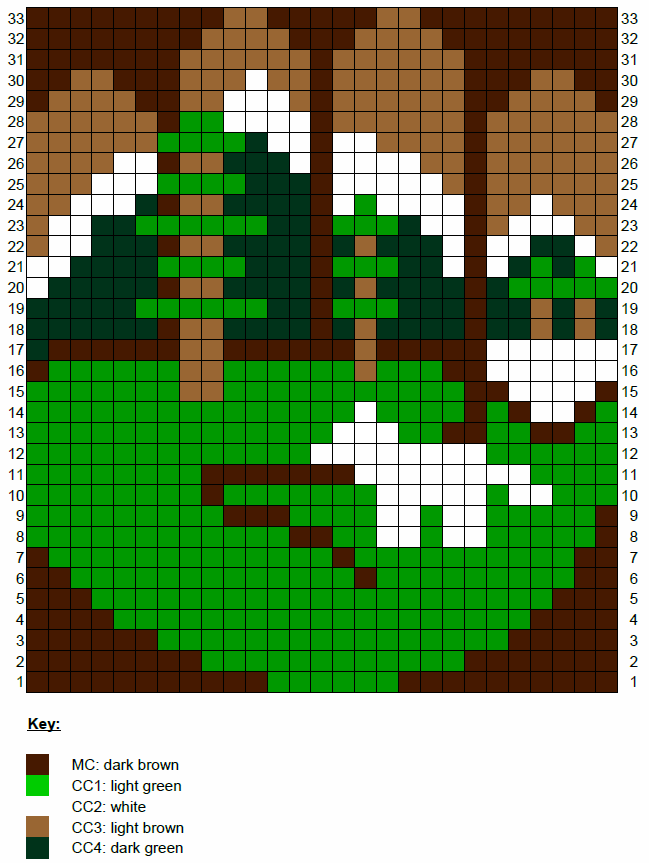
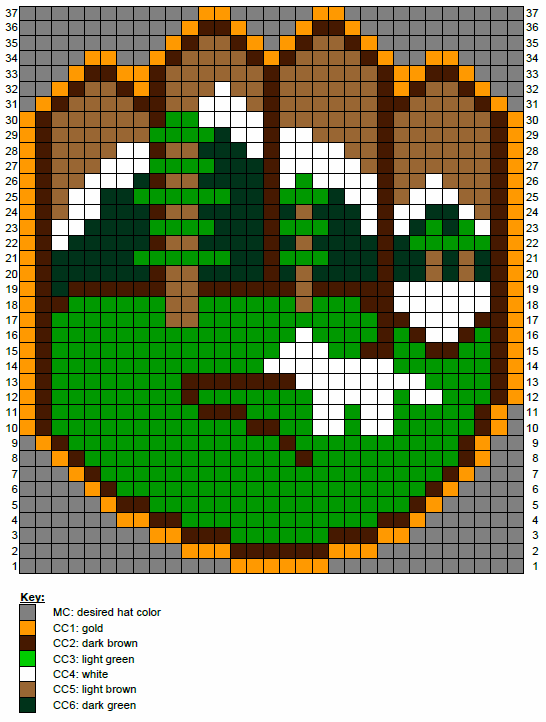
I've been wanting to do hats to support the upcoming science marches. A friend commented “I want an Alt National Parks Service hat” and I thought it was a great idea. I charted it out and got to knitting.

Difficulty level:
Intermediate

Skills Required:
Bind off
Cast on
Color chart reading
Decreases
Intarsia (worked flat, not in the round)
Knit
Purl

Yarn:
Chart 1:
MC: dark brown
CC1: light brown
CC2: white
CC3: light green
CC4: dark green

Chart 2:
MC: desired hat color
CC1: light brown
CC2: white
CC3: light green
CC4: dark green
CC5: dark brown
CC6: gold

Sample uses (amounts are approximate):
Wool Ease (80% acrylic, 20% wool)
Avocado: 20-40 yards
White: 5-10 yards
Forest Green Heather: 10-20 yards
Heartland (100% acrylic)
Sequoia: 125 yards
Vanna's Choice (100% acrylic)
Toffee: 20-40 yards

Needles:
US 6/4.0 mm. Hat is worked both flat and in the round. Needle length for your personal circular knitting preference should be used (double points, 2 circs, Magic Loop)

Gauge:
19 sts/24 rounds = 4 inches in stockinette in needle size required to obtain gauge.
A US 6 (4.0mm) to US 8 (5.0mm) is a suggested starting point.

Notions:
Yarn needle
Stitch marker

Abbreviations:
CC, contrasting color
CO, cast on
K, knit
MC, main color
P, purl
Rnd, round
RS, right side
Sts, stitches
WS, wrong side

Finished dimensions:
Height: 12 inches with 4 inch unfolded brim.
Width: 17 inch circumference across stockinette section.
Fits snugly on my 23 inch circumference head.

Pattern Notes:
There are 2 charts. You will use the first chart if your main color is the same as the darker outlining. The second chart is included if your main color is a different color or if you want to include the outer outlining. Chart 2 is 4 stitches wider than Chart 1.
You may wish to make mini skeins for each color to minimize tangling and to maintain even tension. Certain small chart areas may be done with duplicate stitch if desired.
When changing colors be sure to cross the old color over the new color to avoid holes.

Stitch Pattern:
2x2 rib:
Rnd 1: *K2, p2. Repeat from * to end of rnd.
Repeat rnd 1 for pattern.

Instructions:
Using MC yarn and preferred cast on, CO 80. Place marker and join to work in the round, being careful not to twist.
Work 2x2 rib for 4 inches for a turned up brim, 2 inches for a non-turned brim.

Knit 4 rounds.

Chart 1 set up:
Prep row 1: (RS) K7, work row 1 of chart, k26, turn
Prep row 2: (WS) P26, work row 2 of chart, p27

Chart 2 set up:
Prep row 1: (RS) K5, work row 1 of chart, k24, turn
Prep row 2: (WS) P24, work row 2 of chart, p25

Complete desired chart as written, working in rows rather than rounds. Chart should be read from left to right on purl (WS) rows, and from right to left on knit (RS) rows.

Once the last row of chart has been completed, rejoin to work in the round.
Knit 2 rounds.

Decreases:
Rnd 1:*K8, k2tog. Repeat from * to end of rnd.
Rnd 2:*K7, k2tog. Repeat from * to end of rnd.
Rnd 3:*K6, k2tog. Repeat from * to end of rnd.
Rnd 4:*K5, k2tog. Repeat from * to end of rnd.
Rnd 5:*K4, k2tog. Repeat from * to end of rnd.
Rnd 6:*K3, k2tog. Repeat from * to end of rnd.
Rnd 7:*K2, k2tog. Repeat from * to end of rnd.
Rnd 8:*K1, k2tog. Repeat from * to end of rnd.
Rnd 9:*k2tog. Repeat from * to end of rnd.

Cut yarn 6” from hat. Using a tapestry needle, thread the tail through the remaining stitches and pull tightly to close.

Finishing:

Weave in ends.
Close seam using MC and your preferred seaming method.


Designer and pattern information:

Contact Information
------------------_
Michelle Trudeau Fleming
Website; http://www.ravelry.com/stores/michelle-trudeau-fleming-designs
michelletfleming@gmail.com


Credits
-------
Photographer: Michelle Fleming
Model: Michelle Fleming
Tech editor: Deb Jaworowicz
Test knitter

Copyright Statement
--------------------
© Michelle Fleming, 2017

Date, Version Number
------------------
Version 1, February 2017


Maple syrup

This year is the fourth year that I've tapped my very large maple trees. I don't remember the date that I tapped the trees the first year, but the last two years, the date was a day apart in the first week of March. The high yesterday was 46 degrees (F) after a day of bitter cold, so I probably should have tapped them a couple days ago, but I tapped them with my daughter this morning.

I don't remember when my Dad started making syrup, but I remember collecting sap with him until the time we moved when I was 15.  The trees he tapped were more numerous (but not as large in girth) and more widespread. Since I live in the city, I have only the trees on my lot (4 large maples) and two on the empty lot next door (since I have permission from the people who own the lot). If I wanted to make a greater quantity of syrup, I could find more trees. One year I tapped at the daycare that my daughters went to as a way to teach them about maple syrup and collecting more sap. We don't go through large quantities of syrup, except as gifts, so I'm not too bothered about ending up with more.

I hope my daughters look back fondly at this activity and perhaps make their own when they get older.

It didn't get cold enough last night for the sap to run well today. It's also dreary and drizzly out there today. The best weather for running sap is temperatures above freezing, sunny and no wind during the day and then temperatures below freezing at night. When it is warm, the sap runs up from the roots into the branches because of pressure that grows when the tree warms. During the cool night, the pressure drops and suction helps the tree renew the sap by pulling moisture in through the roots. http://maple.dnr.cornell.edu/produc/sapflow.htm is a great explanation of what's going on in the tree.

Since I was the one wielding the drill, I have no pictures of that part, but C helped me with the rest of it.

For the spiles (the part that sticks out of the tree) that I use, a 7/16 spade drill bit is what I use. Spiles, and other syrup making equipment can be found at smaller hardware stores. Since all I purchased for sap collecting is the spiles, I didn't spend much on this aspect of syrup making, especially since my Dad gave me most of the spiles I have.
Here, C puts the spile in the hole and hammers it in.


Once the spile is secure, so it doesn't fall out or leak, you hang a bucket from it. We use milk type jugs since we go through so many. Some collectors will use tubes to have the sap run to a central collecting area or to buckets at the base of the tree.

The tree will start to heal after 6 weeks or so and sap will stop running out of the hole. Six weeks is plenty of time to make it through syrup season here, but you don't want to tap too early.
I don't know what to expect from this year. We've had some very warm days. Last year was odd and I only had two trees that gave me most of the sap I collected. I only ended up with 5 pints of syrup.

It takes a lot of sap to make syrup. The ratio is roughly 40:1. In other words, it takes about 40 gallons of sap to make one gallon of syrup. Other trees can be tapped as well, but their sugar content isn't as high so it takes even more sap per unit of syrup. I would be better off with sugar maples (there's a reason they have that name), but most of my trees are silver maples. 

The next step will be boiling the sap to make syrup. Boiling the sap reduces the amount of water and therefore increases the sugar content. I believe large companies will freeze the sap to remove water too.  I did that one year...unintentionally. 

I store sap in various containers outside unless it gets too warm. When I went out one morning to continue boiling the sap, I found a pretty thick layer of ice along the top and edges. I punched a hole in it (not with my hand) and was able to lift out this bin shaped chunk of ice that was hollow inside. We lose very little sugar with this method. The girls had fun breaking up the ice.


I'll post more information once I get some sap to boil.

Thanks for reading!

Friday, 3 February 2017

365 days of making

This year, unlike most years, I decided to make a New Year's resolution. I resolve to craft every day.

Keeping this resolution will be easier than most because it's something I enjoy doing, but in the past, I've had weeks where I did little to no crafting and my mood suffered for it. I don't know for sure if the gloomy mood was cause or effect of the lack of crafting, but that's not important today. I tend to feel better when I make things so I want to make things every day.

While I should have started updating this blog at the beginning of the year, I'm going to try catching up on what I've worked on this year and keep this blog as a record of my crafting. I have so far kept my resolution, even if the crafting was 10 minutes of knitting snuck in wherever I could.

Let's start with Totoro.
For those who are not familiar with Totoro, I recommend that you remedy that, but in short he is the title character in the film My Neighbor Totoro by Hayao Miyazaki through Studio Ghibli. He is a wind spirit that takes a couple girls, roughly my daughters' ages when they first saw the film, on magical adventures.

I started Totoro toward the end of 2016, but one of the first things I made this year was the leaf that he wears on his head in one scene.


This brings him close to being finished. I have wire for his whiskers and need to make him an umbrella. I've been nervous about the umbrella, but I think I know how to do it, so I just need to get to it. Here is a front view of him before the leaf. Yes, he's supposed to look a bit demonic.
When I get him finished, I'll send pictures to Tested.com. I sent them pictures in December of the needlefelted Appa that I did a few years ago because they encourage the making of things and have a dearth of fibery goodness on their page. For those of you new to my blog, here's Appa: 

Yes, he's supposed to have six legs. He is a flying bison in Avatar: The Last Airbender.

Thank you for joining me on my 365 days of crafting journey!

Saturday, 16 January 2016

And now for something a bit different.

I don't usually sew. In fact, the sewing machine and I tend to not get along. Unfortunately, I had a project in mind that meant using the sewing machine.

Mom made me some hanging towels years ago and I love them. They hang on the oven door and don't fall off. I always have something in the kitchen to dry my hands on.

In the autumn, I bought these really cute batty hand towels with the thought of turning them into hanging hand towels like the ones my Mom gave me. A couple weeks ago I found the black pot holders I needed at the dollar store near my house. It was time to get sewing.

Thankfully, these require one seam and a button, so it's about my speed. I sewed them up last week and today I put a button on them. Here they are, hanging on my oven.

I love them! I used white buttons that I had left from another project. I learned that I do need to pay attention to the orientation of the towel with regards to the loop on the potholder. My bats ended up upside down on the one on the left. Good thing they're bats, eh?

The one on the right is mirrored, meant to be draped over a bar, so I didn't have to worry about that one. Yes it says "bite me".

They are intended for Halloween, but that won't stop me from using them throughout the year.

The potholders aren't quite as big as the ones that Mom used, but they do go over the handle so they are fully functional.  The first step in making these is gathering the towel in the middle so that they end up the width of the potholder. Then the towel is sewn to the center of the potholder. My seams aren't perfectly center or straight, but that's not obvious now that they're finished.

I may have to do more of these.

Thursday, 12 November 2015

Dabbling in color

So. Since I quit one of my jobs (the one where I left the house for 40+ hours a week, I'm still a mom, wife, etc) in the spring I've been wanting to do something with the crafts I know to bring in some money so that I didn't have to find another lab job. At least not right away.

I'm really enjoying being at home. My older daughter is in school and my younger in preschool so I have the house to myself. I've been trying to finish some things around the house that needed doing and I started making things.

I knew that people wouldn't pay me any reasonable wage to knit. I thought that perhaps I could do some needlefelting, but I just don't enjoy it to the degree that I would need to make enough to sell. Again, people were probably unlikely to pay me a reasonable wage for the fancier items because they take a while to make. I tried making smaller items, but couldn't really get behind it.

I started talking with a couple friend about dyeing yarn to sell. This was an idea I could get behind. I'm interested in gradient/ombre yarns and yarns with a longer color repeat. They have grand plans that sound great, but for now, I just want to start dyeing and selling and see how it goes without making it complex. It will hopefully get us some money to sink into bigger plans and give us some experience so the transition into those plans may go more easily.

My husband has been encouraging me to get dyeing and start by selling at a local meeting. I'm looking into the technicalities of selling at the meeting.

I've started dyeing up some yarn and have already learned lots.

I was able to make a rainbow and black skein for rainbow stripy socks...that are missing purple. This is my test to see how it would look knit up and figure out gauge. I plan to knit these into socks to use as an example. They are dyed to make matching, sport weight socks.


This is one of my favorites, but it doesn't look quite like it does in the picture. It is actually a light turquoise to a darker turquoise to a dusky blue to black. I'm thrilled with how it turned out!


Here is another gradient I did. The photo is more faithful to the colors. It is light pink to dark pink to a purplish color then dark to light gray.


Here's the trio of the latest batch. Rather than gradients, these have long color repeats. The purple and chartreuse has roughly 10 yard repeats as does the black and yellow. The third ball has 10 yards of gray and 5 yards each of purple and fuchsia. 


I think it looks very striking. My husband recommended these colors based on the colors I had chosen for a cowl I knit last spring.

These are the start of what I hope will become a successful yarn dyeing business with friends. Most of the above will be offered for sale.

Monday, 2 November 2015

Necessity is the mother...

A week or so ago, a friend posted a link to this gorgeous shawl:


Yes, that's a knit Maple leaf to use as a shawl.  The pattern is on Ravelry: http://www.ravelry.com/patterns/library/maple-leaf-knit-shawl

Most of you reading may think that this post will be about how I knit this gorgeous shawl and want to show it off, but not yet. I decided that I must knit this shawl. I set out about finding some appropriate yarn with which to knit this shawl, but stopped myself.  

As I got to thinking, I realized I have some Bare superwash wool (with 25% nylon, but that is less important for this project than some) from Knit Picks. I also have Jacquard acid dyes, so I set about to dye some yarn for this shawl. That way, with some luck, I could get exactly what I want.

The pattern calls for fingering, but says you can use sport and it will be more of a wrap. I'm good with that. It calls for 766-984 yards, so I dyed 4 skeins of the Bare, which will give me 1096 yards. This will also give me a bit extra for any shrinkage in the dyeing process.

The colors I used were fire red and brilliant yellow although, since I looked at the color in the tub rather than reading the label, I ended up with a bit of chartreuse in it as well. No matter how yellow it looks in the tub, chartreuse is actually a green. I noticed right away when sprinkling the powder on the yarn, so I stopped and got the actual yellow.


Here you can see the green. It wasn't tragic in this project as a bit of green in the leaves is OK. The yellow was rather chunky, so I added a bit extra. I put the red on both ends. This is before much mixing.


I wanted the yarn to be mostly red with some orange and perhaps a bit of yellow, so I made sure to mix them.


I put on the vinegar, made sure to mix it well, so I wouldn't get white spots and turned on the heat.

The hard part was waiting for it to finish and then waiting for it to dry.

The yellow turned out a bit more yellow than I had planned. I guess it needed more mixing, but I didn't want to have the red completely take over.  There were a few whitish spots, mostly around a couple of the ties, so I went back and painted those. 

They didn't turn out quite how I had envisioned, but I'm happy with the result. I hope it will look good in the shawl. 

The finished (almost dry) yarn. The red isn't as pink as it looks in the pictures. I need to figure out how to get more faithful pictures.

(almost) Time to cast on!